
What Does a Barometer Actually Tell You?

3 minute read
You may have just bought your first barometer, or perhaps you're curious about how this classic weather monitoring instrument works. Whatever scenario you might be in, you have come to the right place. In this guide, we will cover everything you need to know such as reading and calibrating your barometer, and even choosing the right type for your home.
What is a Barometer?
A barometer measures atmospheric pressure which is the weight of air pressing down on the Earth's surface. As pressure changes, so does the weather, which in turn makes a barometer one of the most reliable tools for predicting what the skies are likely to do in the hours ahead.
Pro tip: Rising pressure means improving, sunny weather. Falling pressure means wetter or stormier conditions are on the way.
How does a Barometer work?
The most common type found in UK homes is an aneroid barometer. Rather than using mercury or liquids, it works via a sealed metal chamber that expands and contracts with changes in atmospheric pressure, displayed with a needle moving across a dial. No batteries, no liquids, and highly reliable.
Digital barometers work on the same principle but use electronic sensors to display pressure numerically, often alongside temperature and a 24-hour pressure trend graph.
How do I read a Barometer?
The dial is typically marked in hPa (hectopascals) and/or inHg (inches of mercury). Normal pressure at sea level is 1013 hPa / 29.92 inHg.
| Pressure | Movement | Likely Weather |
|---|---|---|
| High (>1023 hPa) | Rising / Steady | Fine, dry, clear skies |
| High (>1023 hPa) | Falling Fast | Cloudier spells developing |
| Normal (1009–1023 hPa) | Rising | No significant change |
| Normal (1009–1023 hPa) | Falling | Rain becoming likely |
| Low (<1009 hPa) | Falling Fast | Storm or strong winds |
| Low (<1009 hPa) | Rising | Cooler, but clearing |
Always watch the direction of change, not just the number. A rapidly falling barometer is a much stronger storm signal than a low steady one. For more information on barometric readings and converting inches of pressure to millibars, check out our other blog on barometers.
Pro tip: Tap the glass gently before each reading to free up the needle and get more accurate results.
How do I Calibrate My Barometer?
Most barometers are factory-set to sea level, but you'll need to adjust for your local altitude:
- Find your current local pressure at metoffice.gov.uk or bbc.co.uk/weather and enter your postcode.
- Use the small adjustment screw on the back to align the needle with that reading
- Leave it in place for a couple of days to fully settle before relying on readings.
What Type of Barometer Should I Buy?
At Metcheck, we stock a wide range of barometers to suit every home and budget:

Dial Barometers
The most popular choice for home use. Compact, wall-mounted and requiring no batteries, they are available in styles ranging from modern and functional to beautifully crafted wooden mounts.

Banjo Barometers
Traditional wall-mounted instruments with real character. Handcrafted in wood finishes such as mahogany or cherry, many include a thermometer and hygrometer too, making them a three-in-one weather instrument and a much-loved gift.
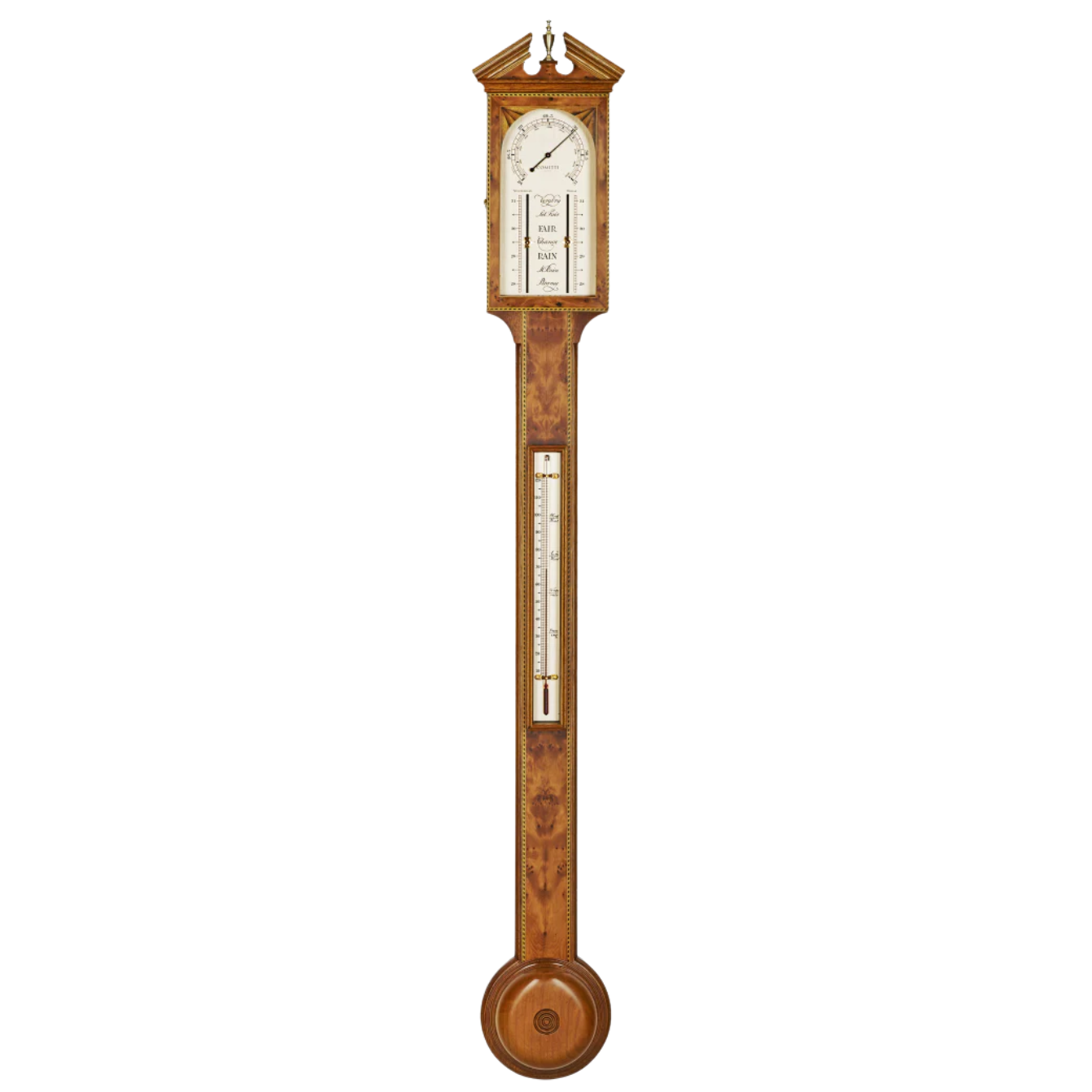
Stick Barometers
The stateliest option. Hand-crafted to heritage designs dating back to the early nineteenth century, these heirloom-quality pieces are built to last for generations.

Digital Barometers
Ideal for enthusiasts who want more data. They display pressure, temperature and trend history including high and low records, making it easier to spot how quickly conditions are changing.